.svg)
Fire & Safety Tips
Divisions
Coming Soon: 2026 Community Wildfire Protection Plan

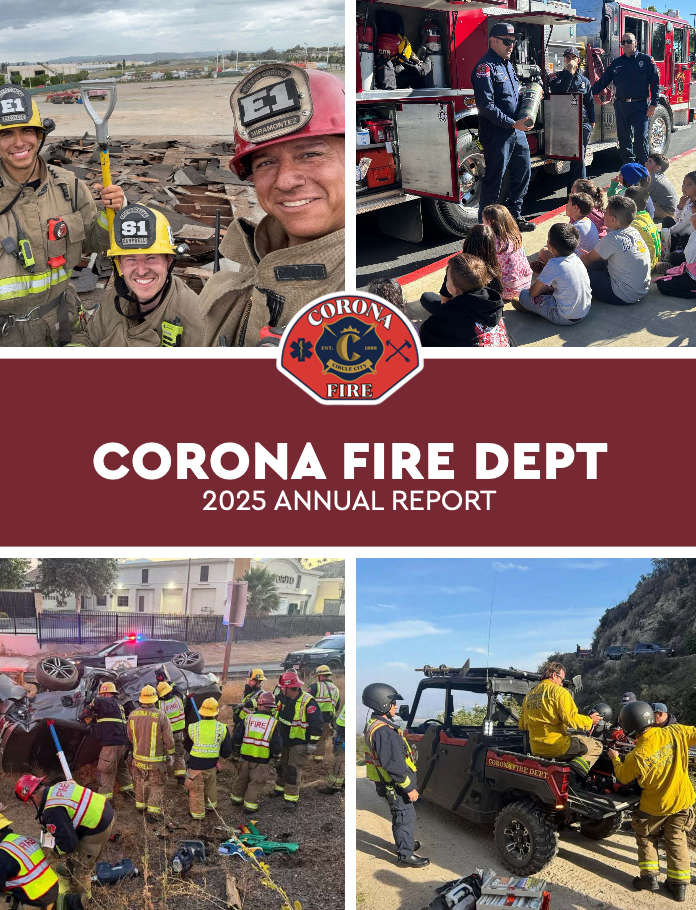
2025 Annual Report
Community Wildfire Protection Plan

Contact Us
Fire Department Headquarters
735 Public Safety Way #201
Corona, CA 92878
Submit Overgrown Vegetation Issue: 951-279-3534
951-736-2220
Fire alarm reports and non-emergency citizen requests: 951-736-2222


.svg)

The Corona Fire Department strives to enhance the lives of our citizens by maximizing safety and prevention, and minimizing potential hazards through education, prevention and planning. Learn about some simple steps you can do to ensure the safety of your family and community.
Downed Power Lines
Never touch a downed or dangling wire or anyone or anything in contact with it. Always assume a downed line is still energized. Report any downed power lines immediately by calling 9-1-1.
Cooking Facts
Cooking fires continue to be the most common type of fires experienced by U.S. households. This is even more apparent during the holidays. Don't become a cooking fire casualty. Learn the facts about cooking fire safety.
Home Fire Safety Inspection
To help reduce your chance of having a fire or other emergency in your home, routine home safety inspections should be done by occupants of the home. In most cases, these inspections will only take a few minutes. Holiday trees, lights and decorations, and candle use are some of the most common causes of fires during the holidays. Learn more about what you can do to prevent holiday fires.
Smoke Detectors & Carbon Monoxide Safety
During a fire, there is no time to waste. A working smoke detector, properly installed, will double your chances of survival during a home fire. A smoke detector will give you the time you need to get out alive. Learn more about proper installation of your smoke detectors and maintenance. Often called the silent killer, carbon monoxide is an invisible, odorless, colorless gas created when fuels (such as gasoline, wood, coal, natural gas, propane, oil, and methane) burn incompletely. In the home, heating and cooking equipment that burn fuel are potential sources of carbon monoxide. Properly installed and maintained Carbon Monoxide (CO) detectors can save your life. Learn about alarms and detectors.
Product Recalls
Consumer Product Safety Commission Search the U.S. Consumer Product Safety Commission website for recent product recalls and safety information.
Unattended Child in Vehicles
Never Leave a Child Unattended in a Vehicle! State law mandates that any child left in a vehicle must have supervision from a person who is 12 years of age or older. Here are some safety tips to help keep children safe.
Water Pool and Safety
Drowning can occur anywhere there is water, be it a pool, a spa, a bathtub, or even a bucket. The Corona Fire Department is dedicated to helping to prevent unintentional injuries to children in our City. The death of any child is devastating, but what makes a death by drowning so tragic is that childhood drowning is 100% preventable. Water safety awareness and education saves lives.
Fire Extinguishers in the Home
Big Fires Start Small
Many people have been severely burned by trying to fight a fire without an extinguisher. Having an extinguisher nearby and knowing how to use it gives you a safe option and a fighting chance to keep a small fire from becoming one that destroys your home.
Don't Forget to Call!
Send someone to call the fire department immediately, even if you have put the fire out. Your firefighters can check to make sure the fire hasn't spread into the attic or other parts of your home. They can also clear the smoke from your home and identify the cause of the fire for you.
Know When to Quit
Fires grow quickly and can flashover to engulf an entire room without warning. Extinguishers are meant for small fires. If you're not immediately successful in extinguishing the fire, get out and stay out.
Purchasing Fire Extinguishers
There are many types of fire extinguishers. A good extinguisher for the home is a multipurpose dry chemical extinguisher containing Monoammonium Phosphate and having a 2-A:10-B:C classification.
Fire Extinguisher Placement
Locate your fire extinguishers where they can be seen, near paths of egress and away from areas that are likely to cause fire such as cooking and heating appliances. Mount your fire extinguishers on wall brackets no more than five feet above the floor. Keep travel distances to extinguishers under 75 feet, more than one extinguisher may be necessary.
Using Your Extinguisher, The P.A.S.S. Method
- P is for PULL, pull the safety pin from the extinguisher handle. The safety pin prevents accidental discharge and should be kept in place when the extinguisher is in storage.
- A is for AIM, aim the extinguisher hose at the base of the flames. Stand back from the fire a distance of 8 feet. Approaching closer puts you in danger and could increase the size of a grease or flammable liquid fire.
- S is for SQUEEZE, squeeze or press the handle of the extinguisher.
- S is for SWEEP, sweep the extinguisher hose from side to side at the base of the flames until the fire goes out.
Click here to learn more about how to use a fire extinguisher. (Interactive)
After The Fire Is Out
It is best to leave the building and wait for the fire department to arrive. Both the smoke from the fire and the extinguishing agent can be irritating to breathe.
Inspection
Inspect your extinguishers regularly. Check that the pressure gauge shows a full charge and check that the safety pin is secured in place. Make these checks a part of your home fire safety inspection.
For more information on Fire Extinguishers - Visit the National Fire Protection Association Webpage.
Edith (Exit Drills in the Home)
Exit Drills In The Home — Get Out Alive!
Death By Fire
Every year thousands of people in the United States die in home fires. Many could survive with early warning and a fast "Get Out, Stay Out" plan. Most fatal home fires occur at night while people are sleeping.
Plan Your Escape
Imagine waking up at 3:00 a.m. to a strange, high-pitched noise. Ten seconds pass before you realize that the noise is your smoke detector alarming. This is not the time to make an escape plan. Make your escape plan today. An escape plan should include two ways out for everyone. Windows and doors are both good exits. If you live in a two-story house, have a safe way to reach the ground. Fire escape ladders can be bought in many stores.
Safe Meeting Place
Have a meeting place outside for everyone to go after leaving the house. Count heads and make sure everyone is there. If someone is missing, tell firefighters when they arrive. Their first priority is protecting lives -- they will search for missing people upon arrival.
Practice Your Plan
Practice your escape plan at least two times each year. Everyone in the family should take part in the "fire drill." Pretend your first way out is blocked by fire, and practice using your secondary exit. Practice in the dark and time your drills.
Crawl Low Under Smoke
During a fire, stay close to the floor. The air at the floor is cleanest and coolest in a fire building. The air above contains deadly smoke, and super-heated fire gases will quickly cause death. Crawl on your hands and knees or on your belly if necessary.
Check That Door For Heat!
Check if a door is hot before opening it. Touch it with the back of your hand. Touch the door, then the doorknob, and then around the crack. If you feel heat, go to another exit to escape. If it's cool, open the door carefully and follow your escape plan.
If You Become Trapped
If you are trapped by flames, close all doors between you and the fire. Stuff the cracks around the door with paper or rags or a rug. Wait near a window. Signal for help with a flashlight or light color cloth. If there is a phone in the room, call 9-1-1 and tell the fire department where you are.
Security Bars & Elevators
If your house has security bars on the windows, be sure everyone in the family knows how to unlock them. If you live in an apartment building, know where all stairways are. Don't plan to use the elevators -- they can fill with smoke, stop between floors, or stop on a floor where there is fire.
No Time To Waste!
If your home is on fire, get out right away. Don't stop to rescue pets or save things. They can be replaced. Follow your escape plan to the safe meeting place and then call 9-1-1 from a neighbor's house.
Double Your Chance For Survival
Most fire deaths occur during the sleeping hours when smoke and fire gases can quickly cause unconsciousness and death. A working smoke detector gives you the chance to wake up and use your escape plan.
Fire Safety Property Owner Resources
Safety Activities Calendar
Safety Activities Calendar
JANUARY
FEBRUARY
MARCH
Home Fire Safety
National Burn Awareness
Poison Prevention Month
APRIL
MAY
JUNE
Earthquake Preparedness
Summer Fire Safety
National Safety Month
JULY
AUGUST
SEPTEMBER
Fireworks Safety Month
Heat Wave Safety
Emergency Preparedness
- Heat related illness prevention
- Never Leave a Child in a Car
- Cooling Centers (Check location for hours): Corona Public Library Corona Senior Center
- Never Leave a Child in a Car
- Cooling Centers (Check location for hours): Corona Public Library Corona Senior Center
OCTOBER
NOVEMBER
DECEMBER
Fire Prevention Month
Kitchen Safety
Holiday Safety
